Grooming Table Hardware • No-Sit Devices • Under-Belly Support • Positioning Equipment • Grooming Restraint Review
Unknown No-Sit Device: Same Table-Clutter Problem, Different Under-Belly Support
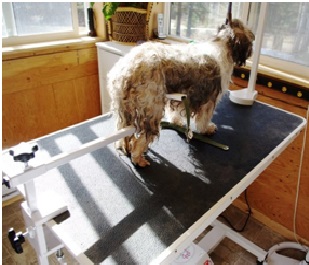
This is an unknown no-sit device in action.
I do not know the official name, brand, or manufacturer, but the concept is obvious enough. It connects to the other side of the table and goes under the belly to keep the dog standing.
Again, my major gripe with these types of accessories is that they take up valuable real estate on the table.
Additionally, in my opinion, they are not a necessity to get the job done.
Even with a difficult sitter, you can use two grooming loops or a grooming harness to accomplish the same task with less setup and more flexibility.
⚠️
Operator rule
Unknown name, obvious problem. Before adding another under-belly contraption to the table, ask whether two loops, a belly strap, or a grooming harness can do the job faster with less clutter.
🗺️
Use This Page Like a Quick No-Sit Device Check
This is a short device review. I do not know the product name, but I know what it is trying to do and why I would not reach for it first.
❓
Unknown Name, Obvious Purpose
It attaches to the opposite side of the table and supports the dog under the belly.
🧰
Table Real Estate Problem
My main complaint is the same: another item on an already crowded grooming table.
🪢
Two Loops or Harness
A flexible restraint setup can usually accomplish the same job with less device hassle.
✅
Operator Verdict
I understand the purpose, but I do not see this as necessary equipment.
❓
Unknown Name, Obvious Purpose
I do not know what this device is called, but I can see what it is trying to do.
This is an unknown no-sit device in action.
As you can see, it connects to the other side of the table and goes under the belly to keep the dog standing.
The idea is simple enough. The dog wants to sit. The groomer wants the dog to remain standing. The device creates under-belly support from the opposite side of the grooming table.
I understand the goal. Sitting dogs can be annoying, especially during undercarriage work, rear-leg work, sanitary work, drying, brushing, or any task where the dog’s rear end keeps dropping at the exact moment you need it standing.
But understanding the goal does not mean I think this is the best solution.
🧰
The Table Real Estate Problem
This is my major gripe with most of these no-sit accessories.
Again, my major gripe with these types of accessories is that they take up valuable real estate on the table.
Grooming tables are already crowded. You have the dog, the grooming arm, the loop, tools, clippers, cords, towels, brushes, hands, elbows, and whatever else has migrated onto the work surface during the day.
Adding another support device means adding another attachment point, another strap or bar under the dog, another thing to work around, another thing to adjust, and another thing to remove when it is not needed.
That is not automatically worth it.
A device used once in a while has to be easy, fast, flexible, and clearly better than the simple method. Otherwise it becomes grooming-room clutter with a purpose statement.
⚠️
Table clutter warning
A no-sit device does not just need to work. It needs to work well enough to justify taking up space, slowing setup, and adding one more object to the table.
🪢
Why Two Grooming Loops or a Grooming Harness Usually Make More Sense
Even with a difficult sitter, I would rather keep the setup flexible.
Additionally, in my opinion, devices like this are not a necessity to get the job done.
Even with a difficult sitter, you can use two grooming loops or a grooming harness to accomplish the same task with less setup and more flexibility.
A two-loop setup can often give the groomer better control without adding a dedicated under-belly device. One loop can help with head or neck positioning. Another can support the body, discourage sitting, or help keep the dog workable depending on the table, arm, and dog.
A grooming harness can also make more sense in some cases because it spreads support across the body instead of adding a single awkward support point under the belly.
Neither method is magic. Restraint still requires judgment. But both options are usually more flexible than installing another mystery accessory on the table.
Swipe left/right to see the full table.
| Option | What It Does | My Take |
|---|---|---|
| Unknown under-belly device | Runs under the belly from the opposite side of the table to discourage sitting. | I understand the purpose, but it adds hardware and takes up table space. |
| Two grooming loops | Gives the groomer more flexible control points using equipment already common on grooming tables. | Usually my preferred direction before adding another device. |
| Grooming harness | Provides body support and positioning control when matched correctly to the dog. | Can be more versatile and less awkward than a single under-belly contraption. |
| Belly strap | Simple support from the grooming arm to discourage sitting. | Often enough for the problem without more table hardware. |
🤔
When This Device Might Still Be Useful
There may be a narrow use case, but it is not where I would start.
This kind of device might be useful for a groomer who repeatedly handles dogs that sit hard, collapse backward, or need under-belly support during a very specific task.
It might also make sense in a shop where a particular groomer has already used it, likes it, understands how to position it, and has a place to store it when it is not in use.
That is different from saying every grooming room needs one.
For me, the device still has to beat the simpler options. It has to be faster than two loops, better than a belly strap, more comfortable than a harness, and less annoying than the table clutter it creates.
That is a high bar for an unknown device whose main selling point appears to be doing a job I can usually solve another way.
✅
My Operator Verdict on This Unknown No-Sit Device
I understand what it is doing. I still do not see it as necessary.
My verdict is simple. I do not know the official name of this device, but I understand the function.
It connects to the other side of the table and runs under the belly to help keep the dog standing.
My problem is the same problem I have with most no-sit accessories. It takes up valuable grooming-table real estate and adds setup for a problem I can usually solve with simpler, more flexible equipment.
Even with a difficult sitter, two grooming loops or a grooming harness can often accomplish the same task with less setup and more flexibility.
I am not saying it cannot work. I am saying I would not buy this kind of device first.
⚠️
Final take
Same category, same concern: too much table hardware for a problem that usually has simpler answers.
❓
Unknown No-Sit Device FAQ for Grooming Rooms
Straight answers about what this device appears to do and why I would usually use something simpler.
What is this device called?
I do not know the official name. This page is based on what the device appears to be doing in the image.
What does it do?
It appears to connect to the opposite side of the grooming table and run under the dog’s belly to help keep the dog standing.
What is my main problem with it?
It takes up valuable real estate on the grooming table and adds another accessory that must be attached, adjusted, removed, stored, and worked around.
Is it necessary?
In my opinion, no. Even with a difficult sitter, two grooming loops or a grooming harness can often accomplish the same task with less setup and more flexibility.
Could it still work for some groomers?
Yes. A groomer who already owns it, likes it, and has a specific use case may find it helpful. I just would not make it my first answer.
What is the main lesson?
Do not add a dedicated no-sit accessory unless it solves the problem better than simpler restraint tools already available in the grooming room.
🐾
Bottom Line: I Would Use the Simpler Setup First
This device is not mysterious in function. It is just not necessary for how I would solve the problem.
This unknown no-sit device connects to the other side of the table and goes under the dog’s belly to keep the dog standing.
My major gripe is that it takes up valuable table space and adds another accessory to a table that is already crowded.
In my opinion, it is not a necessity to get the job done.
Even with a difficult sitter, I would rather start with two grooming loops or a grooming harness because those options usually give less setup, more flexibility, and fewer table-clutter problems.
It may work. It just is not where I would start.