Grooming Dryers • Force Dryers • Stand Dryers • Cage Dryers • Combination Dryers • Cabinet Dryers • Box Dryers • Dryer Safety • Grooming Production
Grooming Dryers: Force, Stand, Cage, Combination, and Box Dryer Decisions for a Working Grooming Room
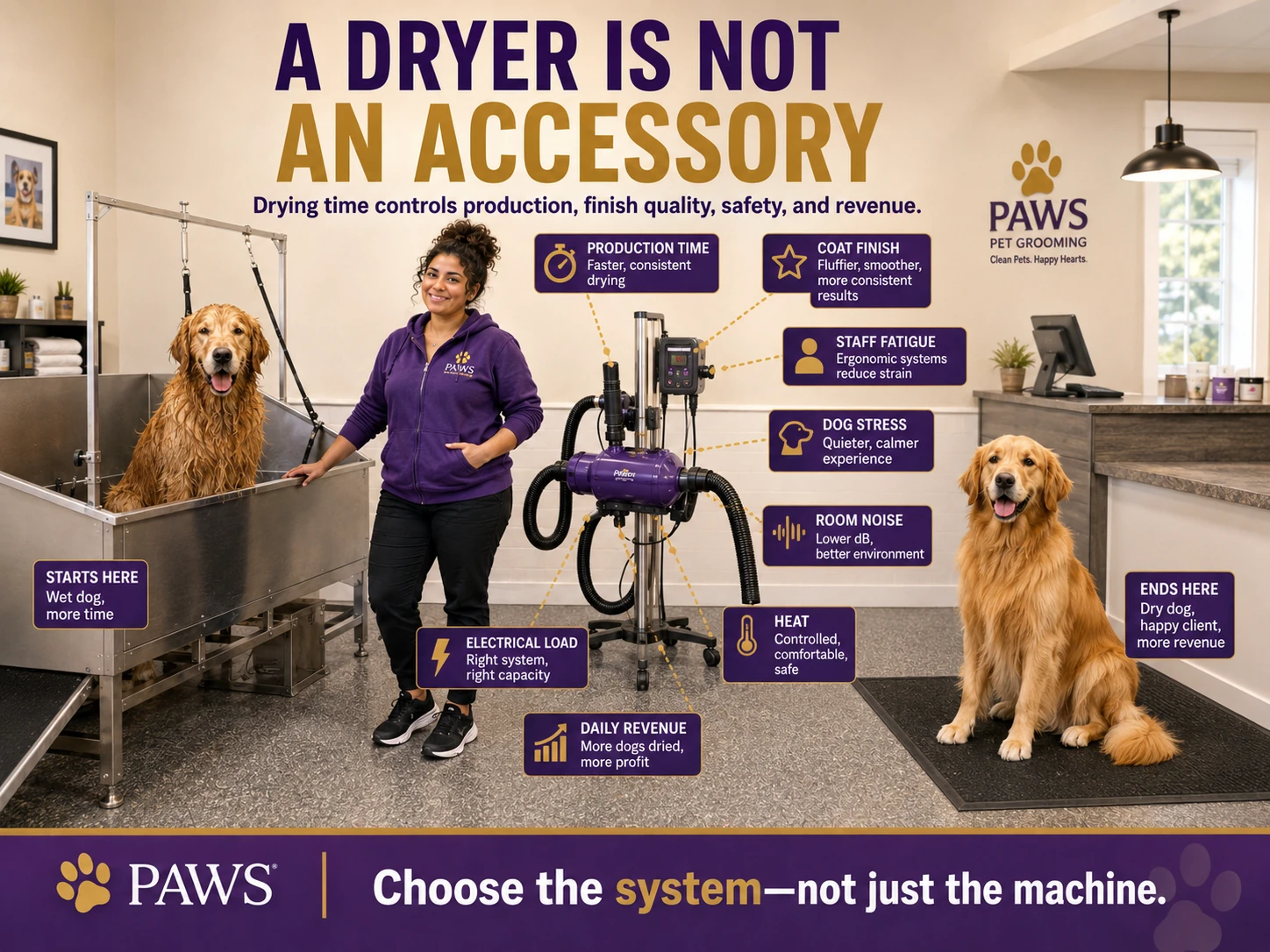
One of the most important aspects of any successful and profitable grooming operation is dryer selection.
Customers do not want to receive back a wet dog, and drying is one of the most laborious and time-consuming portions of most grooms. That means the dryer setup has a direct effect on production time, coat finish, staff fatigue, dog stress, room noise, electrical load, safety, and how many quality grooms the shop can turn out in a day.
In the business of pet grooming, time is money. The faster you can effectively turn out a high-quality groom, the more dogs you can groom per day and the more revenue the grooming room can generate.
But dryers are not just tools that blow air. A dryer can speed up production, improve coat finish, overload a circuit, heat up a room, deafen the staff, stress the dog, or kill a dog when used stupidly.
Drying is where grooming productivity and grooming safety shake hands, then immediately start arguing.
⚠️
Operator rule
A dryer is production equipment, not an accessory. Choose it by what it does to drying time, coat finish, safety, heat, noise, dog stress, electrical load, and staff workflow.
🗺️
Use This Page Like the Grooming Dryer Gateway
This hub explains the dryer system, then points into the individual dryer type pages.
💨
Dryer Types
Force, stand, cage, combination, and cabinet / box dryers each solve different grooming-room problems.
📊
Dryer Terms
CFM, FPM, volts, amps, watts, horsepower, and heating elements all show up in dryer advertising.
⚡
Electrical Reality
Dryers can be amperage hogs. Dual motors and heating elements need serious circuit planning.
🔥
Heat and Safety
Heat-assisted drying tools are not evil. Unmonitored heat-assisted drying is the problem.
🧰
Practical Dryer System
A working shop usually needs a tub-side force dryer and a stand dryer before getting fancy.
✅
Operator Verdict
Dryers should be judged by production, coat quality, safety, electrical load, and real daily use.
⏱️
Dryers Control Time, Finish Quality, and Grooming Room Sanity
Drying is not a side task. It is one of the major production stages of grooming.
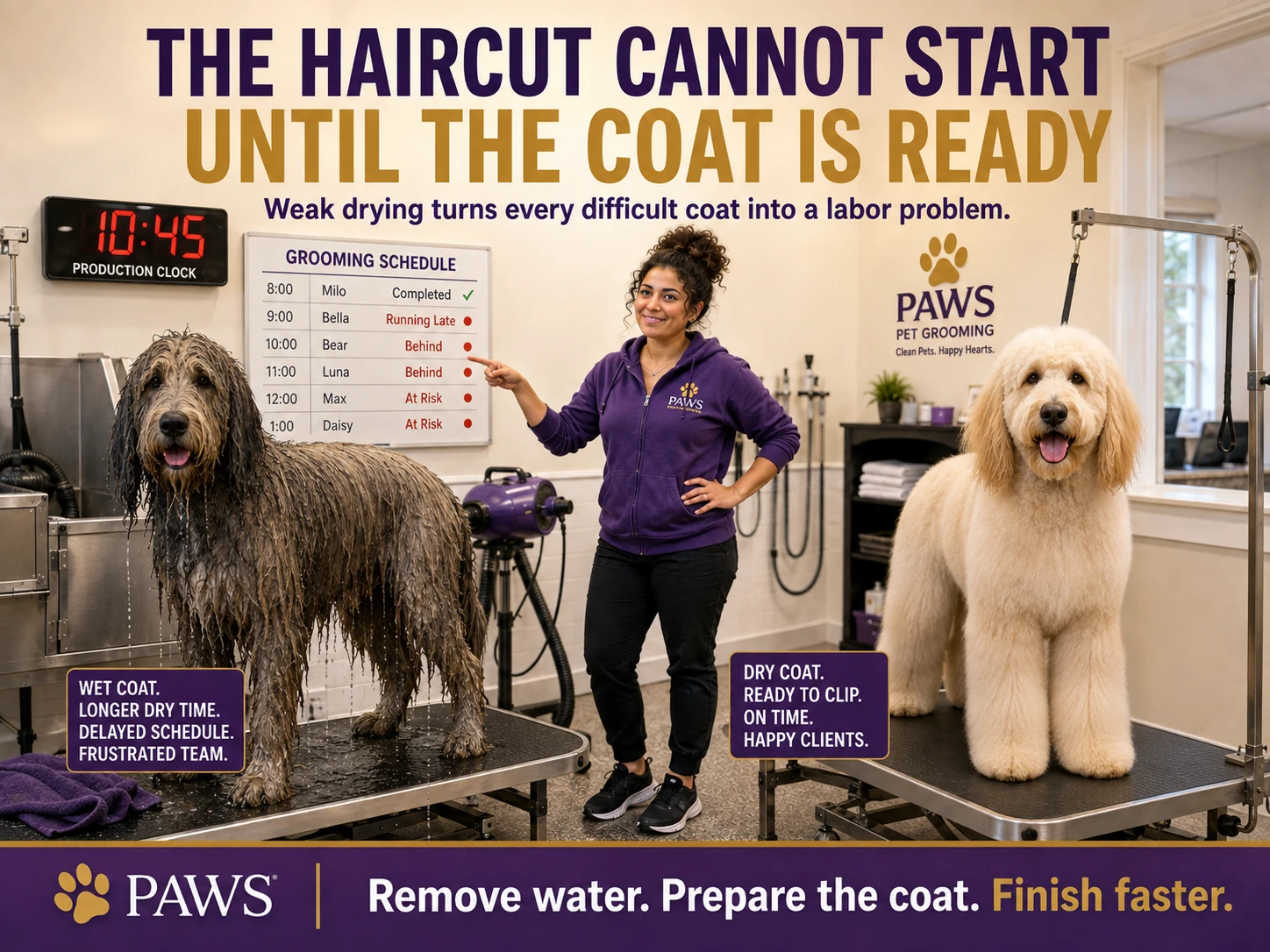
The drying stage can make or break a grooming operation.
A wet dog is not finished. A damp curly coat is not ready for a crisp haircut. A short-coated dog that could have been dried quickly should not tie up a worker longer than necessary. A matted or heavy-coated dog can burn huge amounts of labor if the dryer setup is weak.
Dryer choice affects how fast water is removed, how well undercoat is blown out, how straight the coat becomes before clipping, how much brushing time is saved, how loud the room becomes, how hot the room gets, how much the dog panics, and whether the electrical system keeps up.
A good dryer system helps the grooming room move. A bad dryer system turns the room into a loud, hot, hairy stress cannon.
📌
Production reality
A grooming dryer is only good if it helps the shop turn out a better dog in less time without creating safety, heat, noise, electrical, or coat-finish problems.
💨
Grooming Dryer Category Directory
Use these cards to jump into the individual dryer type pages.
💨
Force Grooming Dryers
The tub-side workhorse for blasting water, loose coat, and undercoat out of dogs fast. Powerful, loud, useful, and not always gentle.
🧍
Stand Grooming Dryers
The finish dryer for hands-free brushing, coat straightening, fluff work, curly coats, and the kind of groom that looks professional instead of half-done.
🏠
Cage Grooming Dryers
Useful for reducing hands-on drying labor, but only when sizing, heat, visibility, thermometers, staff monitoring, and common sense are not optional.
🧰
Combination Grooming Dryers
Jack-of-all-trades dryers that can serve as force, stand, or cage dryers, but usually do not outperform purpose-built tools.
🔥
Cabinet / Box Grooming Dryers
High-production drying equipment that can save labor in busy shops, but also carries serious heat, monitoring, breed, and customer-perception concerns.
📊
Dryer Terms Operators Actually Need to Understand
Dryer ads throw around technical words. Some help. Some mostly decorate the brochure.
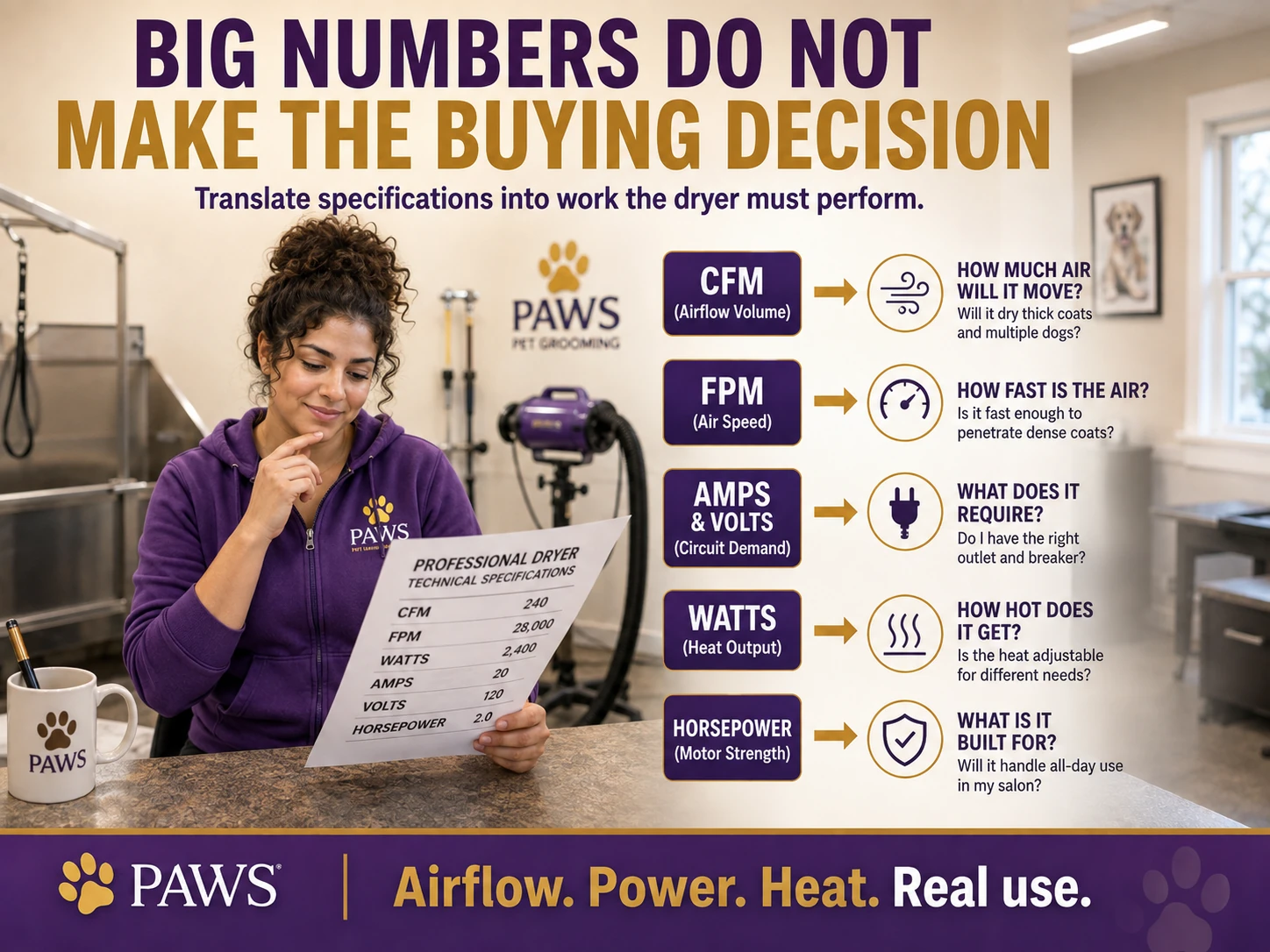
Before getting into the dryer types, it helps to understand the basic terms you will see in dryer advertising.
Some of these numbers matter directly. Some are only useful after you translate them into something a normal human can picture. Some should be taken with a grain of salt because dryer ads can make air speed sound like the machine is preparing to launch the dog into orbit.
Swipe left/right to see the full table.
| Dryer Term | Meaning | Operator Translation |
|---|---|---|
| CFM | Cubic feet per minute. A measurement of air volume. | How much air the dryer moves. Important for drying larger areas, cage drying, and moving moisture. |
| FPM | Feet per minute. A measurement of airflow speed. | I find this harder to picture, so I convert it to miles per hour: FPM × 60 ÷ 5,280. |
| Volts | Electrical energy available to the dryer. | Tells you what type of electrical supply the dryer expects. |
| Amps | The rate of electrical current being used. | Extremely important because dryers, especially heated dryers and dual-motor dryers, can be amperage hogs. |
| Watts | The amount of energy a device uses to perform its function. | Useful for understanding electrical draw, heat, and how much power the dryer consumes. |
| Horsepower | A unit used to measure the rate at which work is done. | Common in motor advertising. One horsepower is commonly treated as 746 watts in electrical power conversion. |
| Calrod heating element | A heavier resistive heating element similar in concept to electric stovetop burners. | Durable and long-lasting, but slower to heat up and cool down because the element has more mass. |
| Coil / wire-wound heating element | Lighter coiled wire heating element often found in hair dryers and toasters. | Heats quickly and responds quickly, but may degrade faster because it operates at very high temperatures. |
📌
FPM translation
If a dryer advertises 10,000 FPM, the rough conversion is 10,000 × 60 ÷ 5,280 = about 113.6 miles per hour. That still may not tell you everything, but at least it gives your brain something more useful than “feet per minute.”
⚡
Electrical Reality: Dryers Can Be Amperage Hogs
The dryer may fit in the room and still not belong on the circuit you plugged it into.
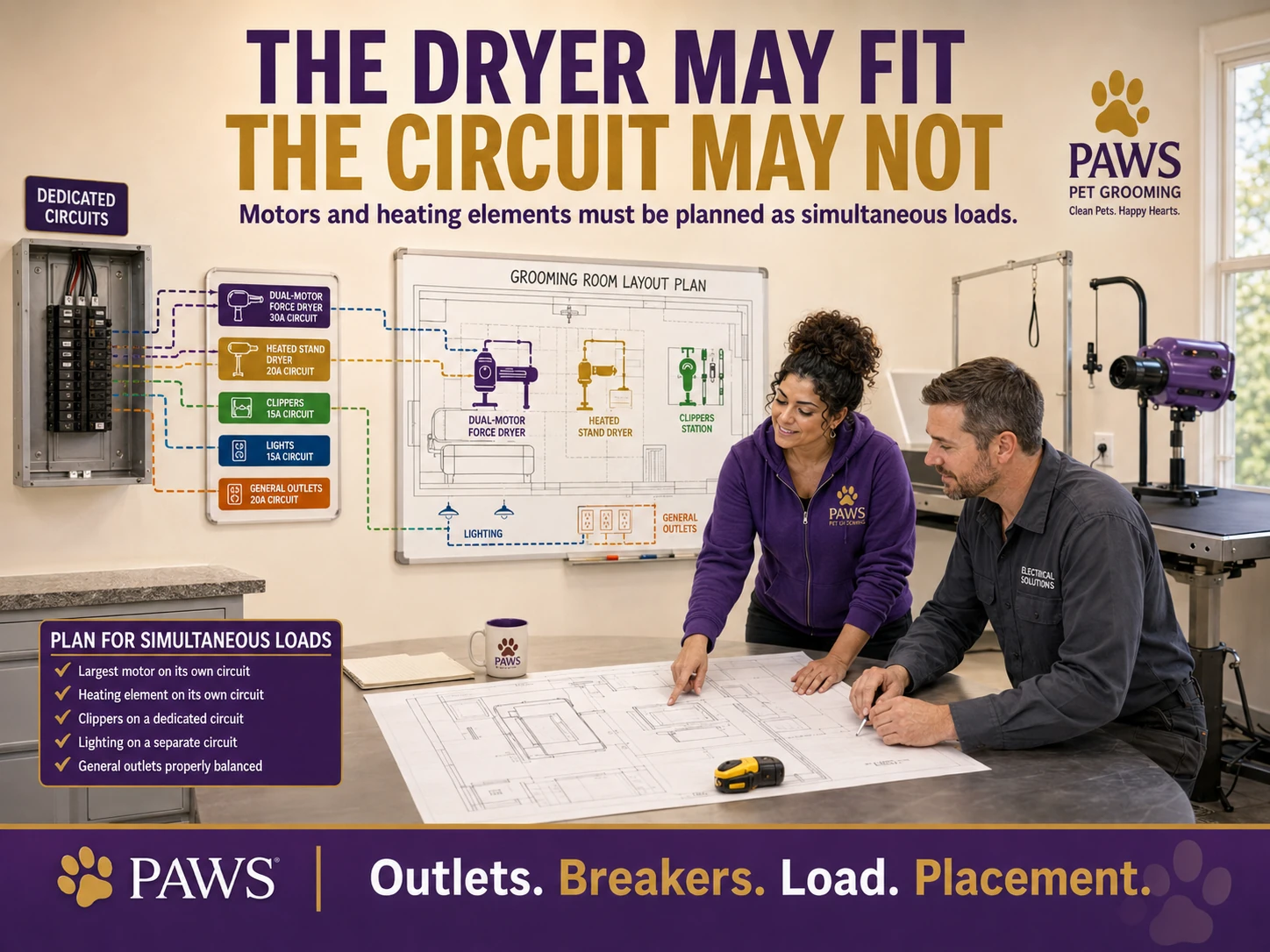
Dryers, especially those with heating elements or large motors, can draw a lot of power.
A dryer that requires 20 amps does not belong on a 15 amp circuit. Even when wire and breaker ratings appear close on paper, continuous load matters.
As a practical example, a 20 amp circuit should not be treated like a permission slip to run 20 amps continuously. Using the 80% continuous-load rule, 20 amps × .8 equals 16 amps.
That matters when a dual-motor force dryer, heated stand dryer, cage dryer, clippers, lights, outlets, and other equipment are all sharing the same electrical reality.
I have seen powerful dryers pop breakers when both motors are thrown on at the same time, especially when other tools or fixtures are drawing from the same circuit.
Best case, dedicated outlets and proper circuit planning are handled before the grooming room is built. Worst case, the bather learns which breaker controls the dryer by walking to the panel every time the room gets busy.
⚠️
Electrical warning
Do not design a grooming room around hope and extension cords. Have qualified electrical work done where required, especially for dual-motor force dryers, heated dryers, multiple drying stations, and busy commercial rooms.
🔥
Heat Is Not Automatically Your Friend
Heat can help drying. Unmonitored heat can injure or kill.
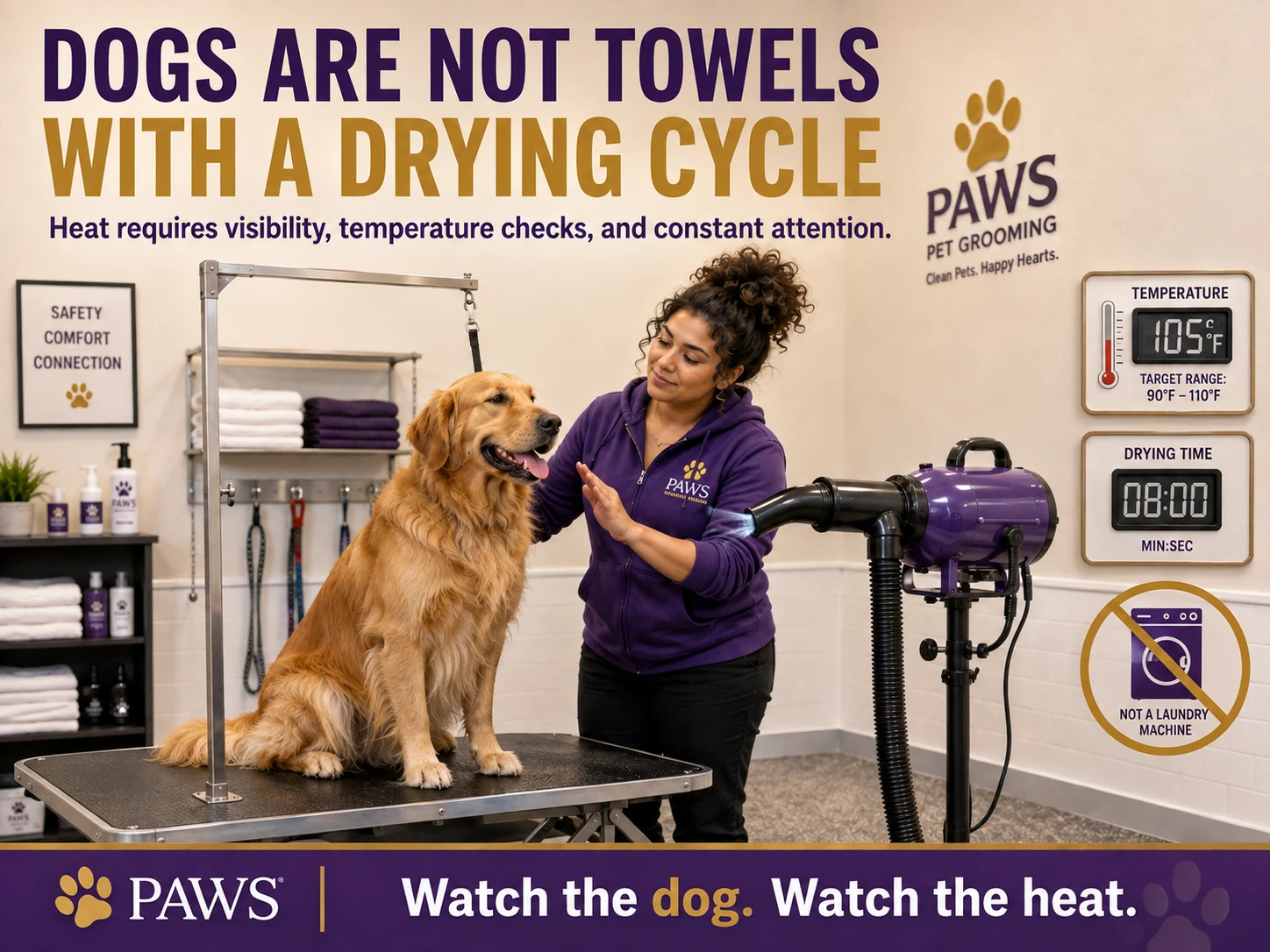
Heat-assisted drying tools are not evil.
Unmonitored heat-assisted drying is the problem.
Some force dryers do not have heating elements, but the motors still heat up during use and transfer warmth into the air exiting the hose. After several minutes, that air can become hot enough that it is uncomfortable or unsafe if held too close in one place too long.
Heated cage dryers and cabinet dryers require even more discipline because the dog may be confined while heat and airflow continue around it.
No heated drying setup should depend on memory, optimism, or “I’ll just be gone a second.”
Dogs are living animals, not towels. They cannot be treated like wet laundry shoved into a machine until the buzzer goes off.
⚠️
Heat rule
If the air is too hot for your hand, it is too hot for the pet. With any heated drying setup, watch the dog, watch the temperature, watch the airflow, and do not let convenience become negligence.
⚖️
Grooming Dryer Type Comparison
Each dryer type has a job. Problems start when people use the wrong dryer as the whole drying plan.
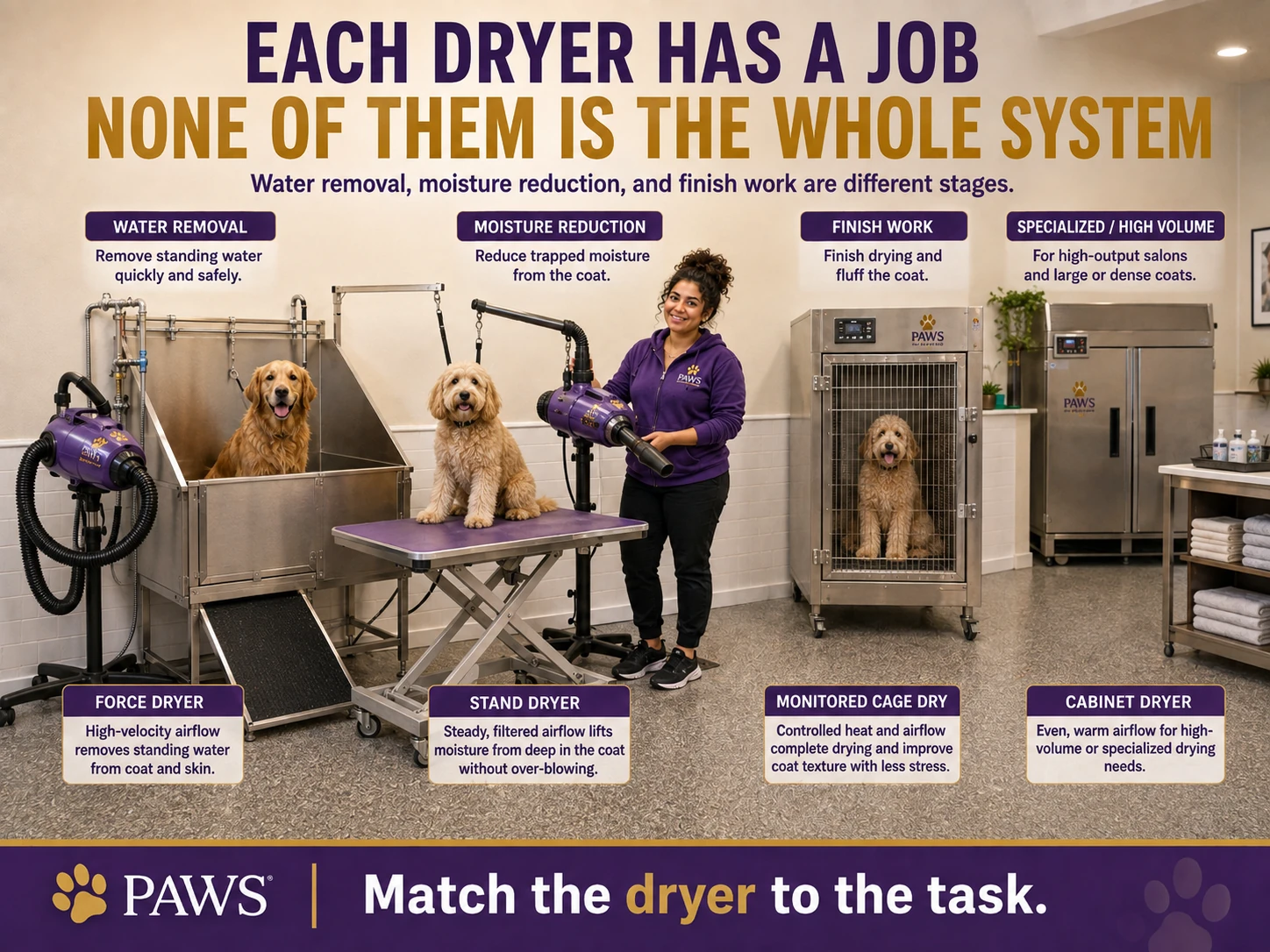
Drying is a sequence rather than a single machine problem. Bulk water removal, moisture reduction, coat straightening, finish work, and specialized high-volume drying each place different demands on airflow, heat, control, dog tolerance, and staff attention.
The comparison table should therefore be read by job, not by which dryer appears most powerful. A strong system combines equipment so each stage is handled by the tool that performs it safely and efficiently.
Swipe left/right to see the full table.
| Dryer Type | Main Job | Main Advantage | Main Risk | Operator Take |
|---|---|---|---|---|
| Force dryer | Blast water and loose coat out of the dog, usually near the tub. | Fast water removal, undercoat removal, high production value. | Noise, heat buildup, dog stress, hose control, electrical draw. | One of the most useful dryers in the shop. I want one in any serious grooming room. |
| Stand dryer | Finish drying, fluffing, brushing, and coat straightening. | Hands-free warm air while the groomer brushes and works the coat. | Wheel failure from dog hair, space use, and lower brute-force drying speed. | Absolute necessity for quality finish work and curly-coated dogs. |
| Cage dryer | Move air around caged dogs to reduce moisture and hands-on drying labor. | Can free staff to work on other dogs or tasks. | Heat injury, poor monitoring, wrong sizing, blocked view, lazy drying habits. | Useful only with rules, visibility, thermometers, sizing, and constant attention. |
| Combination dryer | Serve as force, stand, cage, or backup dryer depending on setup. | Flexible startup or backup tool on a limited budget. | Jack of all trades, master of none. | Good startup or backup dryer, not my first-choice production setup. |
| Cabinet / box dryer | Dry dogs inside a drying cabinet or kennel-style drying chamber. | Can reduce labor and increase production in busy shops. | Heat, confinement, breed risk, monitoring failure, customer perception. | Powerful labor-saving equipment only for serious, disciplined, monitored use. |
🧰
My Practical Dryer System for a Working Grooming Room
Do not build the dryer plan around one magic machine. Build it around stages of drying.
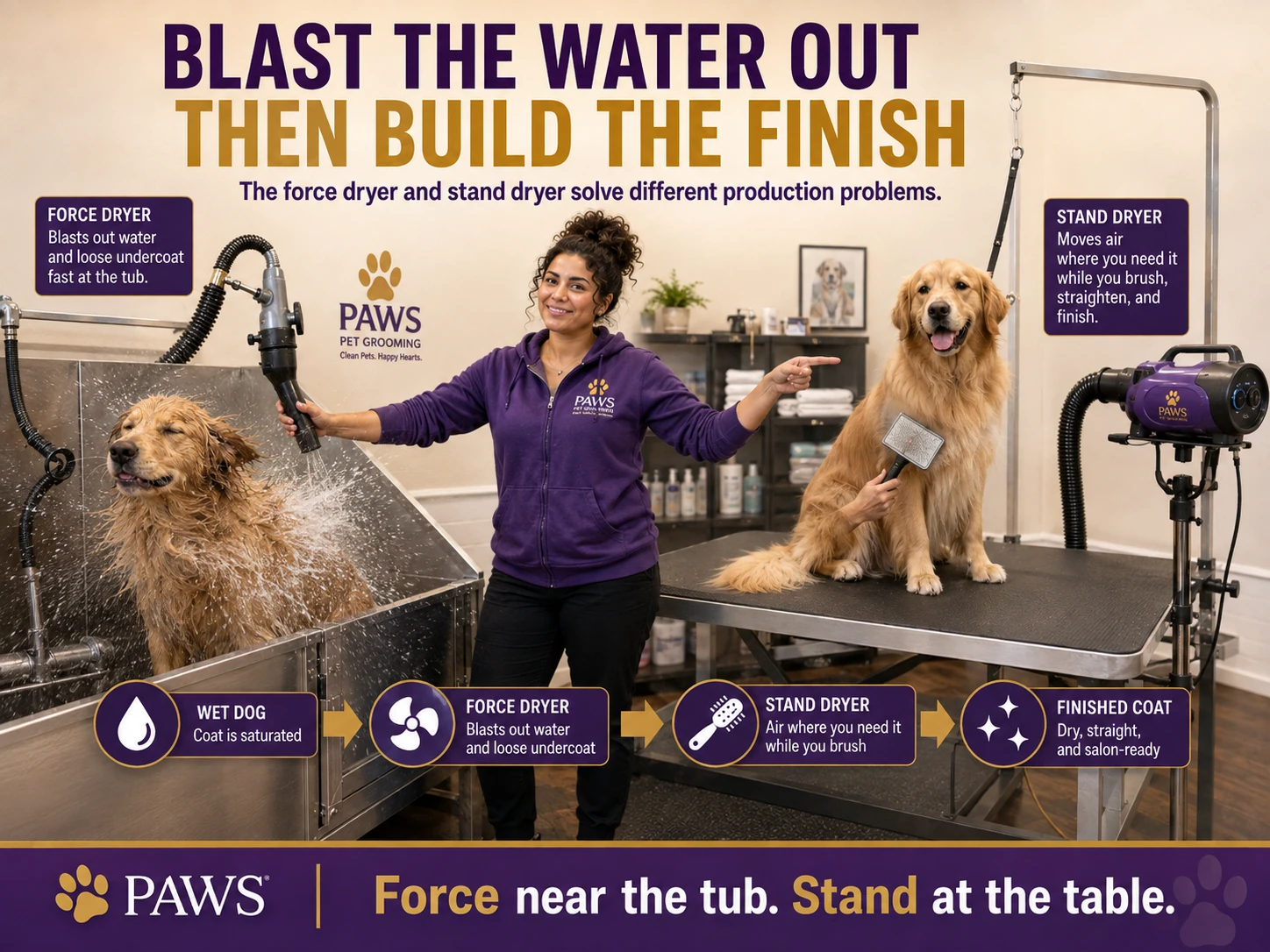
For most serious grooming rooms, the basic dryer system starts with a force dryer and a stand dryer.
The force dryer belongs near the tub. Its job is to blast the majority of the water out of the coat, blow loose coat away, and save huge amounts of towel and brushing time.
The stand dryer belongs in the finish process. Its job is to provide controlled, often heated, hands-free airflow while the groomer brushes, separates, straightens, and finishes the coat.
Cage dryers can be useful when used as part of a controlled workflow: short-coated dogs can continue drying while staff work elsewhere, and longer-coated dogs can lose excess moisture while waiting for hand drying. That is not the same thing as using a cage dryer as a lazy total drying solution.
Combination dryers can help a startup or serve as backup equipment. They are useful because they do several things. They are limited because they usually do not do any one thing as well as a dedicated dryer built for that job.
Cabinet and box dryers are a high-volume labor-saving decision. They can make sense in a busy shop with strict safety discipline, but they are not casual equipment and they are not a substitute for supervision.
📌
Simple dryer system
Blast water out with the force dryer. Finish and straighten coat with the stand dryer. Use cage or cabinet drying only as controlled support, not as a lazy replacement for proper hand drying.
🦺
Grooming Dryer Safety Rules
Dryers save labor. They also create heat, noise, airflow, electrical, and monitoring responsibilities.
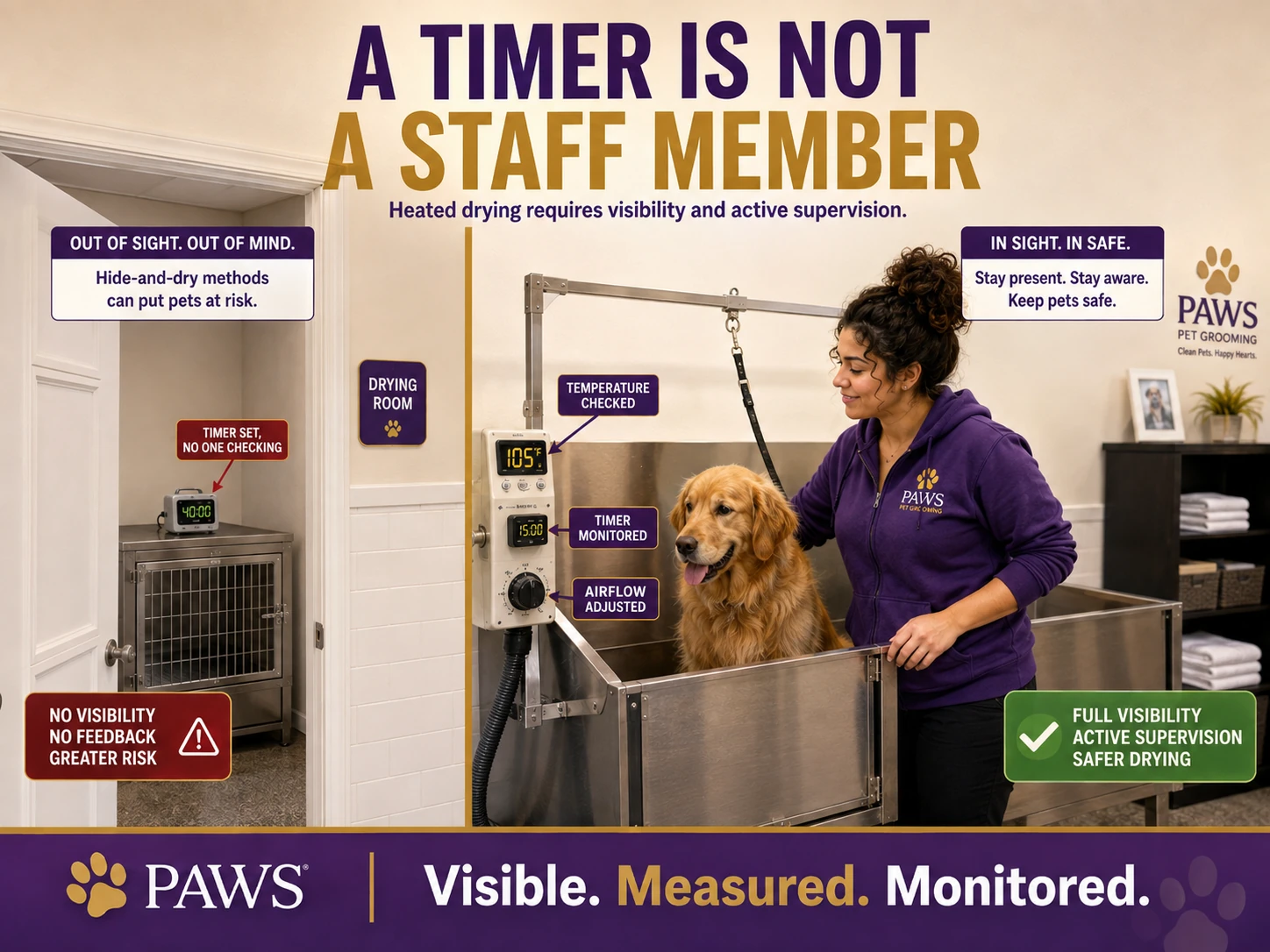
Dryer safety has to be built into the room and the workflow. Staff need visibility, reachable controls, thermometers where heat is used, clear inspection routines, and enough staffing that a dog is never treated as a timed load of laundry.
A timer can support supervision, but it cannot replace it. The dog’s breathing, posture, temperature, stress, coat condition, and response to the equipment must remain visible to a person who can stop or change the drying method immediately.
- Keep a hand in the airflow when using powerful force dryers so you know what the pet is feeling.
- If the air is too hot for your hand, increase distance, reduce heat, change method, or stop.
- Do not use heated cage or cabinet drying without visible temperature monitoring and staff attention.
- Dogs in cage dryers or cabinet dryers must remain visible to staff, not tucked behind a wall out of sight.
- Do not oversize heated cage dryers because “bigger air” sounds faster. Too much heated air can create a dangerous cage environment.
- Be extremely cautious with brachycephalic breeds, elderly dogs, infirm dogs, compromised dogs, stressed dogs, and dogs that cannot tolerate heat or confinement well.
- Do not use cage drying as a total drying solution for long, delicate, curly, or finish-sensitive coats.
- Check cords, hoses, filters, nozzles, heating elements, wheels, cage connections, and breaker behavior as part of normal equipment maintenance.
- Do not build a dryer plan that requires staff to remember every risk while tired, rushed, wet, behind schedule, and surrounded by barking dogs.
- Never let convenience become complacency. That is how drying tools become dangerous.
🚫
Common Grooming Dryer Buying and Use Mistakes
Bad dryer decisions usually show up as slow production, bad finish, hot dogs, loud rooms, and popped breakers.
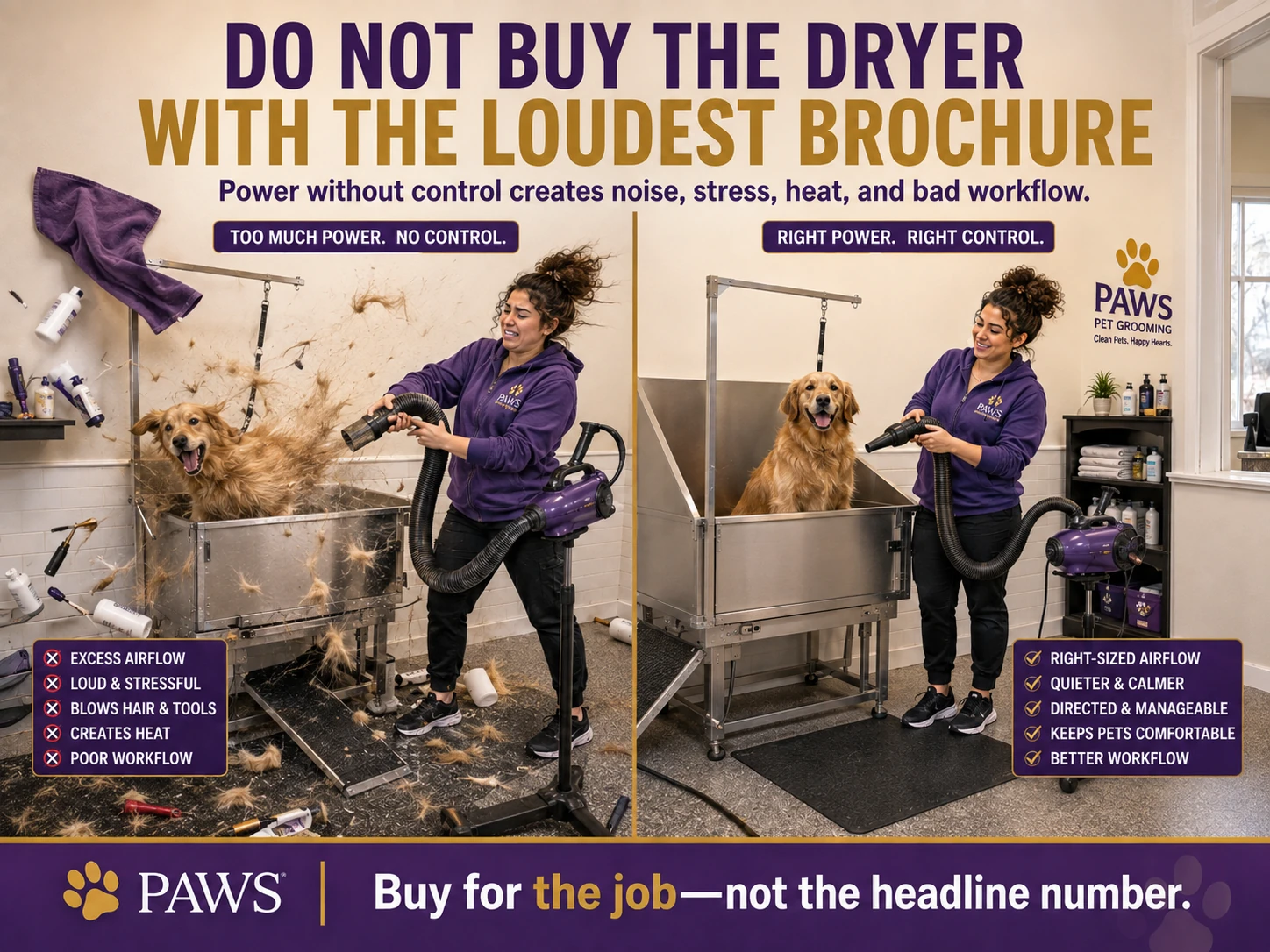
The largest advertised number is not automatically the best operating choice. Airflow that is too aggressive, heat that is poorly controlled, or a machine that overwhelms the circuit can slow the room, frighten dogs, scatter hair and tools, and increase staff fatigue.
Compare the dryer against the actual job, coat types, room size, hose handling, sound level, electrical capacity, controls, maintenance, and staff skill. Right-sized control usually produces more usable work than raw power the room cannot manage.
Swipe left/right to see the full table.
| Mistake | Why It Hurts | Better Move |
|---|---|---|
| Buying one dryer and expecting it to do everything | Drying has stages: water removal, moisture reduction, finish drying, fluffing, and coat straightening. | Match dryer type to the drying stage. |
| Ignoring electrical draw | Powerful motors and heating elements can overload circuits. | Plan outlets, breakers, circuit load, and dryer placement early. |
| Treating heat as always better | Heat can dry faster, but it can also injure or kill when unmonitored. | Use heat carefully, visibly, and with constant attention. |
| Using cage drying as a lazy total drying solution | Many coats need hand drying and brushing to finish correctly. | Use cage drying to remove excess moisture, then finish properly. |
| Buying only for power | Too much power can create noise, stress, tangling, heat, and hose-control problems. | Buy for the job, not for the biggest number in the ad. |
| Forgetting staff fatigue | Noise, heat, hose handling, wheels, cords, and airflow all affect the people doing the work. | Judge dryers by daily use, not product photos. |
✅
My Operator Verdict on Grooming Dryers
Dryer selection is one of the biggest production decisions in the grooming room.
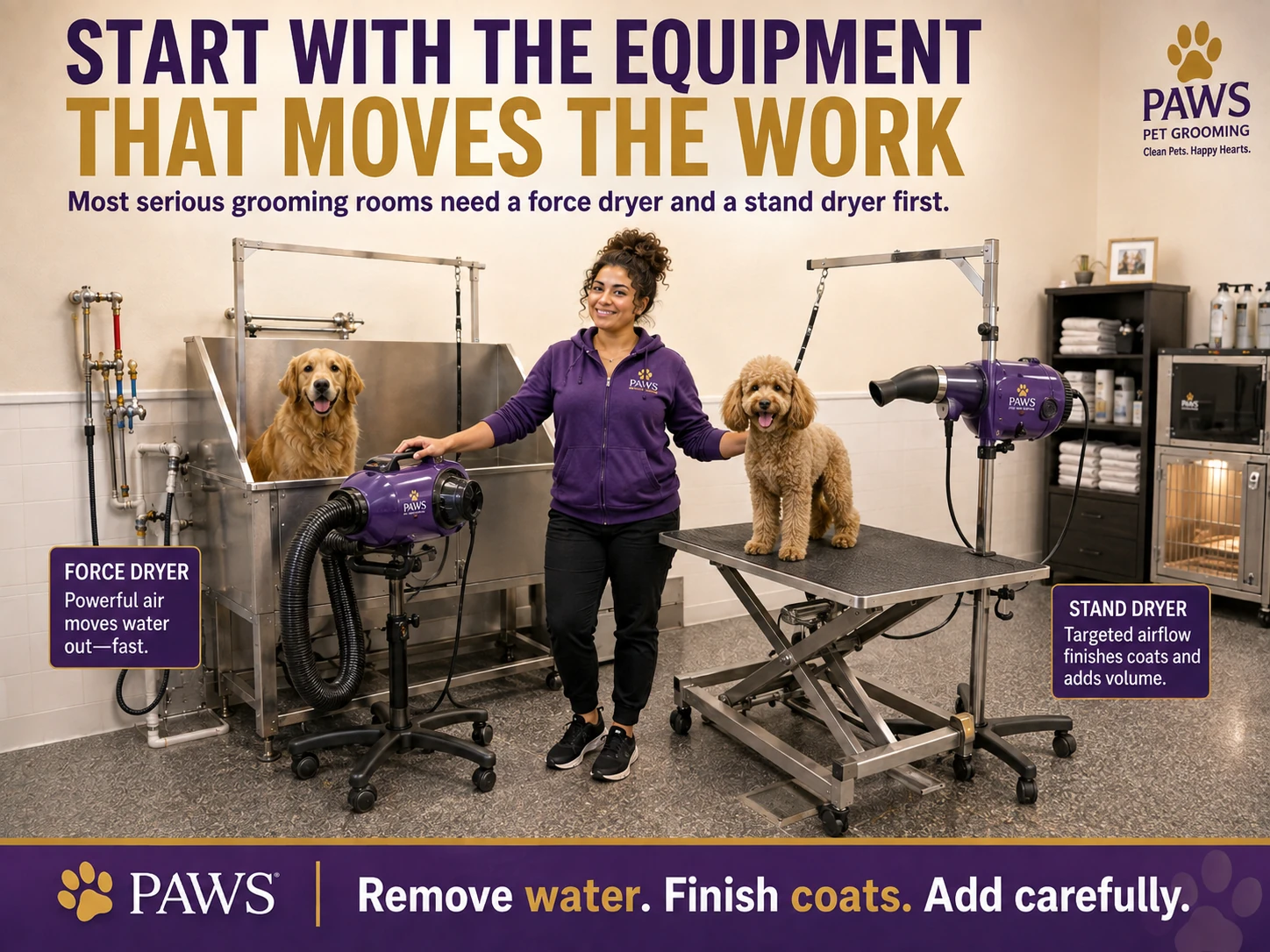
My verdict is that most serious grooming rooms need at least one strong force dryer and one good stand dryer.
The force dryer handles the heavy water removal near the tub. The stand dryer handles finish work, fluffing, coat straightening, and hands-free drying while the groomer brushes and works the coat.
Cage dryers can be a wonderful and profit-enhancing addition when used correctly, but they require discipline. Visibility, correct sizing, temperature monitoring, and staff attention are not optional.
Combination dryers can be useful startup or backup tools, especially for a small one- or two-person operation, but they usually become a compromise once the shop grows.
Cabinet and box dryers can save labor in high-volume shops, but they come with serious safety, monitoring, breed, confinement, heat, and customer-perception concerns.
The right dryer setup should help you turn out a better groom in less time without making the dog suffer, the staff deaf, the room hotter than necessary, or the breaker panel part of the grooming schedule.
⚠️
Final take
Dryers make money when they reduce labor and improve finish quality. They create risk when heat, noise, electrical draw, dog stress, and monitoring are treated like details instead of operating rules.
❓
Grooming Dryer FAQ
Five practical answers about dryer systems, specifications, safety, electrical planning, and the equipment a working grooming room should start with.
What dryer equipment should a professional grooming room start with?
Most serious grooming rooms should begin with a strong force dryer near the tub and a good stand dryer at the grooming table. The force dryer removes bulk water and loose coat. The stand dryer supports brushing, fluffing, coat straightening, and finish work. Specialized drying equipment should be added only when the workload and safety system justify it.
Why is one dryer usually not the whole drying system?
Drying has separate stages: removing bulk water, reducing remaining moisture, preparing the coat, and building the final finish. Force, stand, cage, combination, and cabinet dryers perform those jobs differently. Expecting one machine to handle every coat and every stage usually creates slower production or weaker finish quality.
What specifications matter when comparing grooming dryers?
Air volume, air speed, controllability, heat, amps, volts, watts, motor design, hose handling, noise, filters, serviceability, and build quality all matter. Large numbers only become useful when translated into how the dryer will perform on real dogs in the actual room and on the available electrical system.
What is the biggest dryer safety rule?
Never treat heated or confined drying as a set-it-and-forget-it process. Dogs must remain visible, temperatures and airflow must be checked, and staff must be able to respond immediately. A timer is useful as a reminder, but it is not supervision and cannot evaluate the dog’s breathing, stress, posture, or heat tolerance.
Why should electrical planning happen before dryer placement?
Dual-motor force dryers and heated stand, cage, or cabinet dryers can draw substantial current. The room needs properly sized circuits, outlets, breakers, and simultaneous-load planning. A dryer that repeatedly trips a breaker is not merely inconvenient; it shows that equipment selection and infrastructure were not planned as one system.
🐾
Bottom Line: Dryers Are Production Equipment With Safety Consequences
The dryer setup should make the grooming room faster, safer, cleaner, and more professional.
Grooming dryer selection matters because drying consumes time, labor, electricity, attention, and safety margin.
A force dryer helps remove water and undercoat quickly. A stand dryer helps finish the coat correctly. Cage dryers can help production when monitored. Combination dryers can help on a budget or as backup. Cabinet and box dryers can save labor in busy shops when used with real discipline.
The wrong dryer setup slows the room, stresses dogs, ruins coat finish, pops breakers, creates heat problems, and gives staff one more thing to fight.
Buy dryers like an operator. Match the dryer to the job, the coat, the dog, the room, the electrical system, and the level of staff supervision the tool requires.